The Role of Bearings in Motor Performance and Longevity
Discover how bearing selection, lubrication, alignment, and maintenance drive motor efficiency, reduce vibration, and extend service life.
Core function — In electric motors, bearings are the unseen components that keep the rotor centered, supported, and free to spin with minimal friction. By carrying both radial and axial loads, they protect the stator air gap, preserve electromagnetic efficiency, and stabilize the shaft through a wide speed range. Properly selected bearings reduce heat, cut energy draw, and enable consistent torque delivery, especially during start and acceleration. Their stiffness and precision influence rotor dynamics, damping unwanted vibration and avoiding premature resonance. Small differences in internal clearance, preload, and geometry can change noise levels, operating temperature, and ultimately motor lifespan. A well-matched bearing transforms electrical power into motion with less loss, allowing higher power density and longer service intervals. Conversely, marginal choices amplify misalignment, elevate wear, and increase maintenance demands. Understanding bearing roles at a system level—mechanical, thermal, and electromagnetic—sets the foundation for motors that run cooler, quieter, and more reliably over an extended service life.
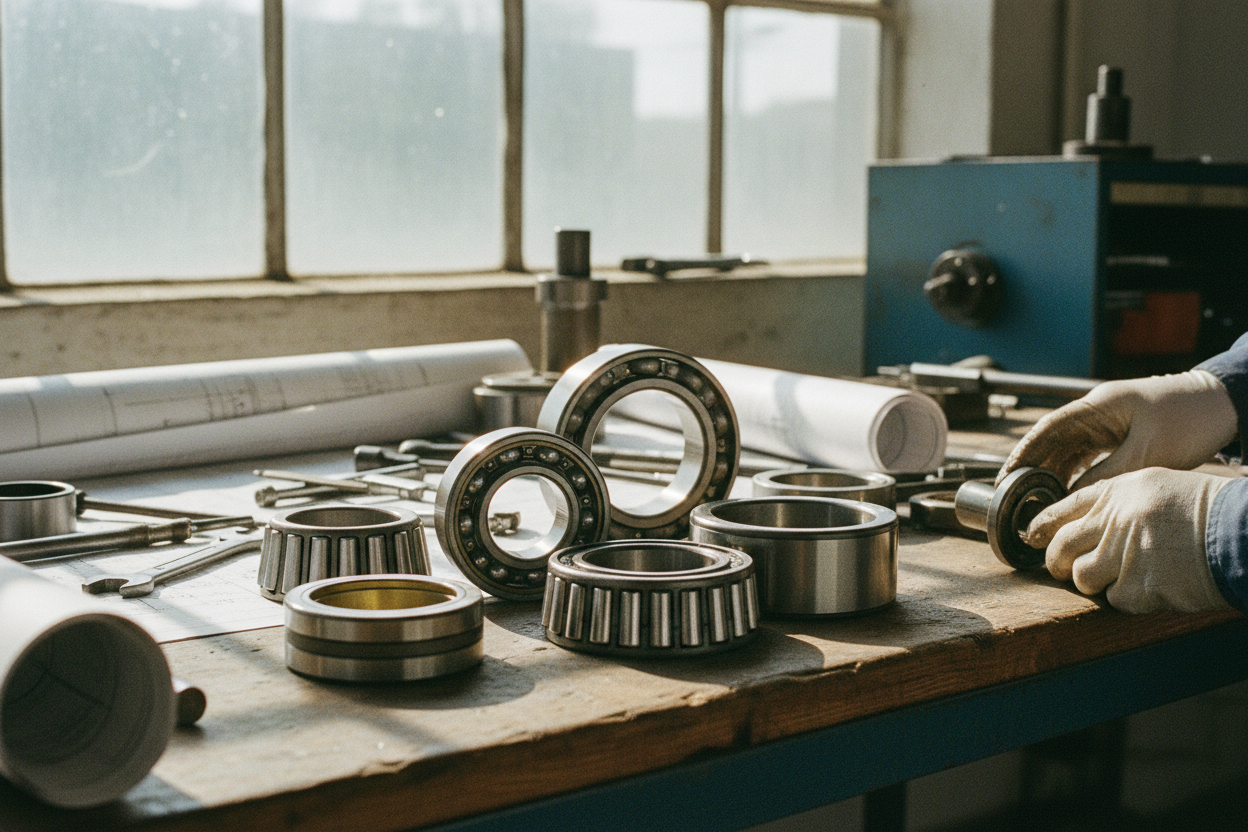
Selecting types — The bearing style should suit the motor's load, speed, and duty profile. Ball bearings excel at high speeds with moderate loads and low friction, widely used in fans, pumps, and general-purpose drives. Cylindrical roller bearings boost radial capacity for heavier conveyors and compressors, while angular contact or tapered roller bearings handle mixed loads with higher axial stiffness. Spherical roller options tolerate misalignment in rugged mounts, and sleeve (journal) bearings provide ultra-smooth, quiet operation for large or high-speed rotors when a hydrodynamic film is stable. Selection also hinges on precision class, cage design, and compatible lubricant. The right preload or internal clearance limits shaft movement without over-heating. Oversizing raises drag and temperature; undersizing risks fatigue and brinelling. Environmental factors—dust, moisture, chemicals, or elevated temperature—drive sealing choices and material preferences. Matching type, size, and precision to the motor's real operating envelope enhances efficiency, stability, and reliability.
Lubrication and sealing — The life of a bearing is governed by lubrication, which builds a protective film that separates surfaces and controls friction. In motors, grease is common for simplicity, while oil systems serve high speeds or high temperatures. The right base oil viscosity aligns with speed and load; too thin risks metal contact, too thick raises churning losses. Grease fill must be balanced: excess causes heat, shortage leads to starvation. Additives help with oxidation and wear, but only if compatible with seal materials and speed factors. Effective sealing is equally vital. Contact seals block contaminants but add drag; non-contact and labyrinth seals lower friction while resisting dust and spray. For oil systems, filtration and controlled flow minimize contamination and foaming. Moisture intrusion accelerates corrosion and lubricant breakdown, so breathers and proper storage matter. By optimizing lubricant type, quantity, and sealing method, motors maintain cooler operation, extended grease life, quieter acoustics, and predictable maintenance intervals.
Installation and alignment — Even premium bearings fail if installation is flawed. Cleanliness is non-negotiable; microscopic grit becomes abrasive under load. Press fits must be applied to the correct race to avoid brinelling, and thermal mounting techniques reduce damage risk. Shaft and housing tolerances determine fit; too tight elevates temperature, too loose allows creep and fretting. Accurate alignment of couplings prevents overhung forces and limits misalignment, a key trigger for heat, noise, and early fatigue. Check soft-foot conditions on the motor base and verify runout and balance to protect high-speed performance. Proper preload settings keep rotors stable without inducing excess torque. Insulated bearings or shaft grounding mitigate electrical discharge from variable-speed drives, preventing fluting and surface erosion. Finally, torque control, calibrated tools, and clear handling procedures preserve geometry and cage integrity. Getting these fundamentals right at commissioning yields lower losses, reduced vibration, and a longer, more dependable service life.
Operating dynamics — How a motor runs shapes bearing stress patterns. Frequent starts and stops raise boundary friction and thermal cycling; steady operation favors stable films and longer life. High-speed service demands low-drag designs, precise clearance, and low-viscosity lubricants, while heavy loads call for higher capacity and robust preload control. Vertical mounts increase axial load; belt drives add radial tension and potential misalignment; shock loads require greater margin and tough race materials. Variable-speed operation changes vibration signatures, possibly crossing critical speeds; a bearing with suitable stiffness and damping avoids resonance issues. Ambient heat, dust, or washdown conditions influence sealing and lubricant choices, and dictate relubrication intervals. Application examples illustrate the range: quiet, efficient HVAC fans prioritize low noise and minimal drag; conveyors demand load capacity and debris resistance; precision spindles pursue stiffness and runout control. Tuning bearing attributes to real-world duty cycles elevates efficiency, steadies torque, and safeguards longevity across diverse motor applications.
Monitoring and maintenance — Condition-based care preserves bearings and boosts motor reliability. Routine checks of temperature, vibration, and acoustic signatures reveal early distress from imbalance, misalignment, or lubrication loss. Techniques such as envelope analysis, high-frequency vibration, and ultrasound can detect incipient spalling, cage wear, and contamination. Trending current draw may expose rising friction or seal drag. Grease programs should reflect speed factor, load, and environment, using measured quantities and clean tools to avoid overfill or dirt ingress. Plan re-greasing or oil changes before oxidation shortens film strength. When failures occur, root cause analysis distinguishes false brinelling from true fatigue, identifies stray electrical paths, or uncovers fit errors and shaft geometry issues. Documenting findings refines selection and procedures, building a feedback loop that reduces downtime. With disciplined handling, aligned mounting, correct lubrication, and data-driven inspection, motors achieve predictable maintenance windows, lower lifecycle cost, and a markedly longer bearing lifespan.