Soundbar vs. Bookshelf Speakers: Better Audio for Your TV and PC
Soundbar or bookshelf speakers for TV and PC? Compare audio quality, setup, features, and budget to choose the best fit for your room and habits.
Understanding the Basics
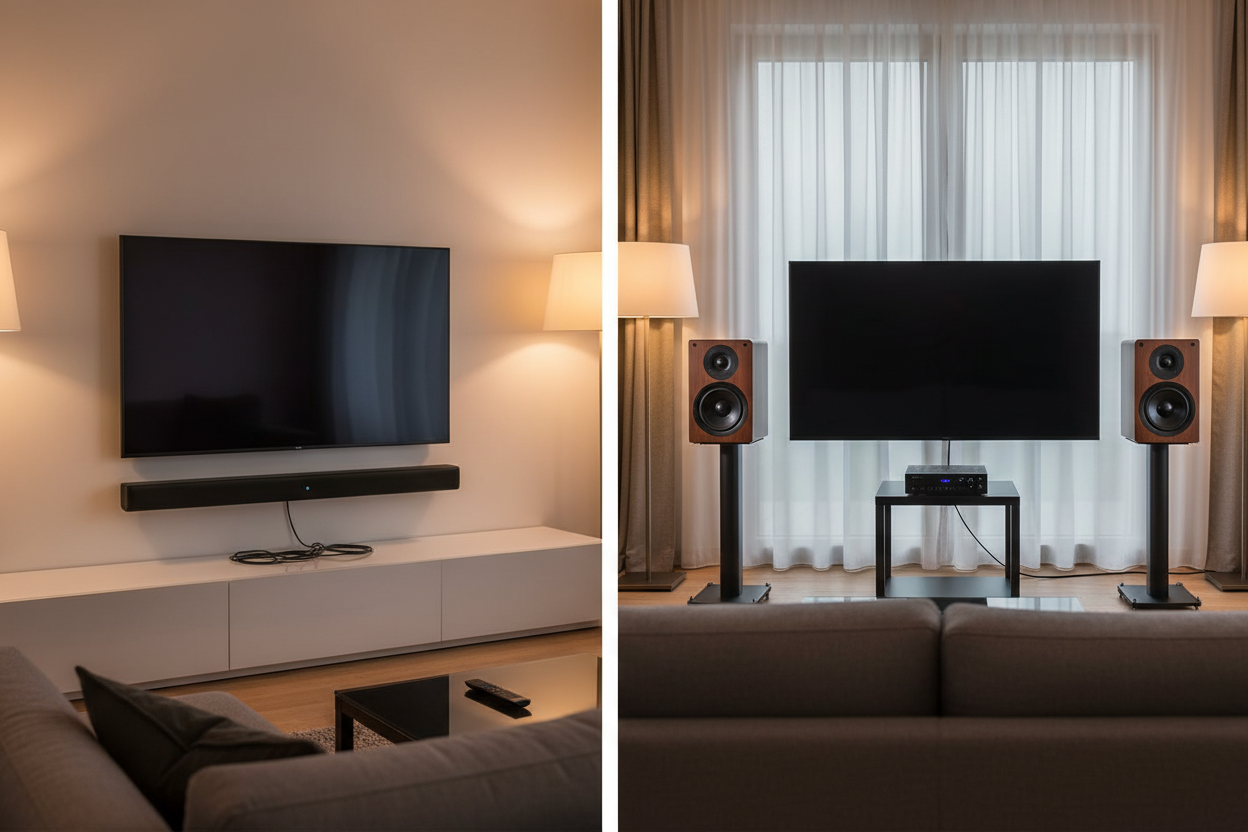
Soundbars and bookshelf speakers both aim to elevate the thin, flat audio of most TVs and monitors, yet they take very different paths to get there. A soundbar is an all-in-one system that places multiple drivers in a single, elongated cabinet, often paired with a compact wireless subwoofer. It's designed for simplicity, quick setup, and wide dispersion to cover a couch or desk area with minimal fuss. Bookshelf speakers, by contrast, are traditional stereo speakers that typically require an amplifier or powered versions with built-in amps. They prioritize channel separation, stereo imaging, and dynamic headroom, often delivering a more precise and natural presentation. For a TV, a soundbar is tidy, easy, and space-efficient. For a PC, powered bookshelf speakers can create a nearfield listening experience with clarity and depth. Deciding between them hinges on your room size, placement flexibility, desired immersion, and willingness to tweak settings or add components.
Audio Quality and Immersion
When it comes to pure sound quality, bookshelf speakers often edge out soundbars with superior stereo imaging, soundstage depth, and tonal accuracy. Their separated left and right cabinets allow better channel separation, which can make vocals feel centered and instruments occupy defined spaces. Soundbars counter with DSP and virtual surround processing that can widen the stage and simulate height or rear cues from a single position. This can be impressive for movies and games, creating a cinematic feel in rooms where physical speakers are impractical. However, virtual effects rely on room acoustics and listener position, while bookshelf speakers deliver honest placement and natural timbre. Bass is another key factor: a soundbar bundle with a subwoofer can punch above its size, while bookshelf speakers may benefit from adding a dedicated sub and proper crossover settings. For music-first listeners, the fidelity of quality bookshelves shines; for movie-night impact, a soundbar's processing can be compelling.
Setup, Connectivity, and Compatibility
A major advantage of soundbars is plug-and-play simplicity. With HDMI ARC/eARC or optical, your TV can pass audio and even control volume with a single remote. Many soundbars also support Bluetooth, and some include USB or aux inputs, simplifying a PC connection. Bookshelf speakers require a bit more planning: powered models need only a source connection, but passive speakers demand an amplifier or AV receiver plus speaker wire. For PCs, you might route audio via USB DAC, 3.5 mm, or audio interface for cleaner signal and better signal-to-noise. Bookshelves ask for thoughtful placement, toe-in, and spacing for optimal performance, while soundbars excel at centered placement under a display. Consider CEC for unified control, lip-sync settings to align audio and video, and EQ or room correction features. If you want minimal cables and instant operation, a soundbar wins; if you enjoy dialing in sound, bookshelves offer more flexibility.
Space, Design, and Everyday Use
Your environment strongly influences which option fits best. A compact desk benefits from nearfield bookshelf speakers placed on isolation pads or small stands, forming an equilateral triangle with your listening position for precise imaging. In a living room, a low-profile soundbar keeps the setup tidy, avoids cable clutter, and integrates seamlessly with a wall-mounted TV. Room shape matters too: reflective surfaces, hard walls, and irregular layouts can help or hinder virtual surround, while bookshelves need breathable space from walls for balanced bass. Consider subwoofer placement options and whether your building tolerates low-frequency energy; soundbars often include night modes and dialogue enhancement for late viewing. Daily usability is key: auto power-on, remote control, input switching, and clear status indicators make a difference. If aesthetics and convenience rank highest, a soundbar is compelling. If you prioritize listening position accuracy, height adjustability, and speaker positioning, bookshelf speakers reward careful setup.
Budget, Value, and Upgrades
Both paths span a wide range of price tiers, but their value proposition differs. A soundbar provides a self-contained solution: amplification, processing, and drivers are all engineered to work together, delivering predictable results for the cost. Upgrades typically mean replacing the unit or adding a compatible subwoofer or wireless surrounds if supported. Bookshelf speakers can evolve over time, letting you upgrade amplification, add a sub, or swap speakers without discarding the whole system. While this modularity can cost more upfront, it offers a longer upgrade path and potential gains in transparency and dynamic range. Consider the total cost of ownership: cables, stands, and room treatment can elevate bookshelf performance. On the other hand, a soundbar's all-in-one convenience reduces hidden expenses and setup time. If you prefer to buy once and be done, a soundbar is efficient. If you enjoy tinkering and incremental improvements, bookshelves deliver enduring value.
Practical Recommendations
Match your choice to real-world use. For a living room focused on movies, casual TV, and quick control, a soundbar with a capable subwoofer provides impactful dialog intelligibility, wide dispersion, and simple operation. For a PC desk, powered bookshelf speakers excel in nearfield clarity, making music, editing, and gaming cues precise and engaging. If you are a music-first listener or care about mix accuracy, prioritize bookshelves and consider adding a sub with careful crossover tuning. If you frequently host movie nights or need a clean look, choose a soundbar with EQ presets and night mode. In apartments or shared spaces, both solutions benefit from volume limiting, bass management, and placement that reduces wall coupling. Whichever you pick, fine-tune with positioning, room-friendly EQ, and routine firmware or settings checks. The best choice is the one that fits your room, habits, and expectations for immersion, clarity, and everyday convenience.