Motor Control Basics: From Starters to Soft Starts
Explore motor control from across-the-line starters to soft starters and VFDs, covering protection, torque, power quality, and application selection.
Fundamentals of Motor Control. Electric motors convert electrical energy into mechanical motion, but effective operation depends on thoughtful motor control. At its core, control aims to manage starting, stopping, direction, protection, and sometimes speed or torque. A basic control scheme combines power components such as a contactor, overload relay, fuses or a circuit breaker, and a control transformer, with logic implemented via control circuits, pushbuttons, selectors, and auxiliary contacts. The challenge is balancing performance with reliability and safety, reducing inrush current impacts while delivering enough starting torque for the load. Industrial applications like conveyors, pumps, and fans each impose different demands, from high starting torque to smooth ramp-down to prevent mechanical shock. Good design addresses electrical stresses on the supply, mechanical stresses on couplings and belts, and thermal stress on windings. Clear documentation, labeled wiring, and consistent lockout-tagout practices ensure safe operation and faster troubleshooting, while standardized components simplify maintenance and inventory across diverse motors and control panels.
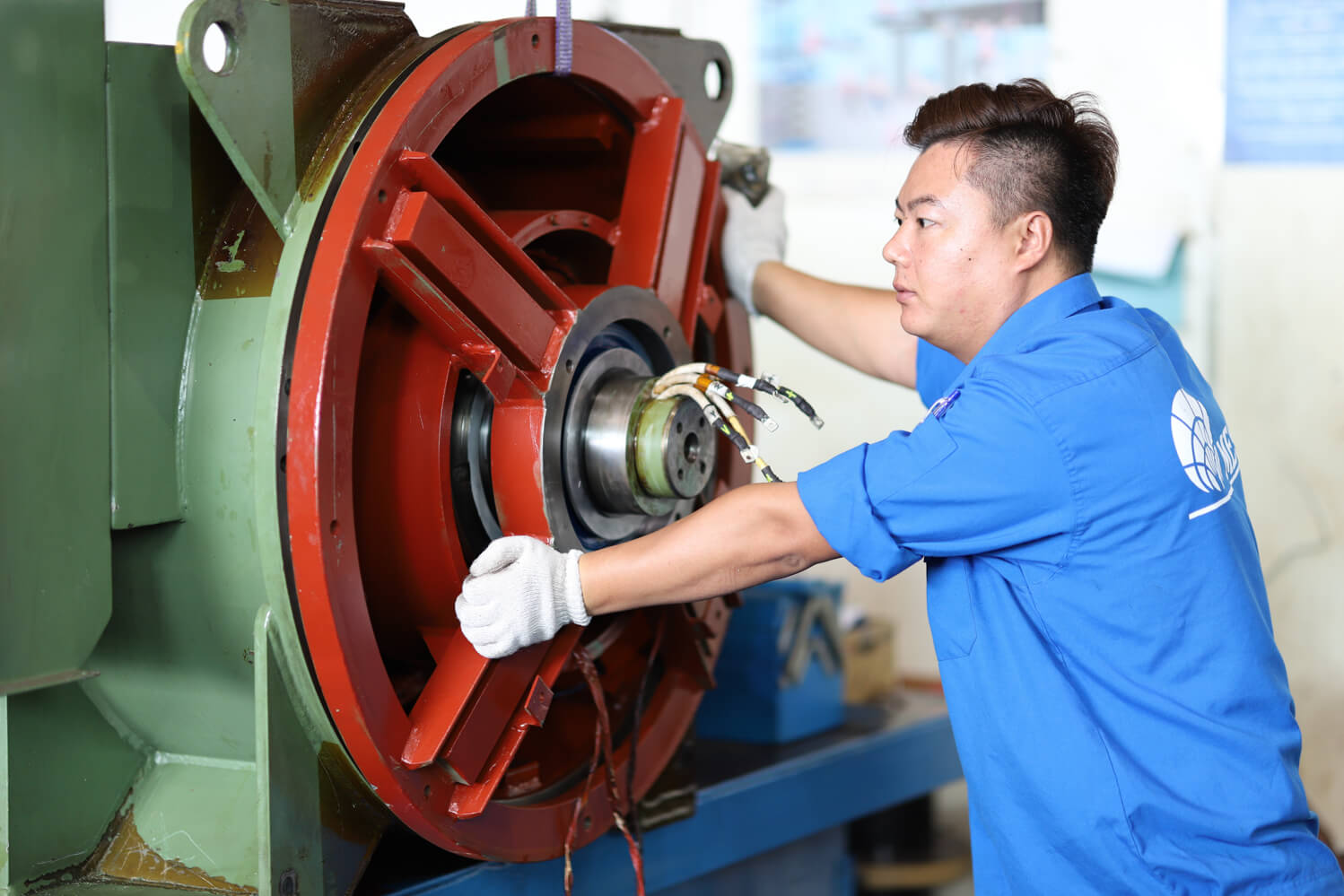
Across-the-Line Starters. The simplest approach, the across-the-line or direct-on-line (DOL) starter, applies full line voltage to the motor instantaneously. This yields maximum starting torque, quick acceleration, and minimal control complexity. A DOL starter typically consists of a contactor, overload relay, and short-circuit protection, with start-stop controls and interlocks. The trade-off is high inrush current, often several times the full-load current, which can cause voltage dips, nuisance trips upstream, and mechanical stress on shafts, couplings, and driven equipment. DOL is ideal for small, robust motors, stiff power systems, or applications where rapid starts are essential and the mechanical system tolerates shock. Good practice includes verifying conductor sizing, setting the thermal overload to match nameplate data, and adding auxiliary contacts for status indication. Where process control is simple, downtime must be minimal, and budgets are tight, DOL remains a reliable, durable baseline for motor control.
Reduced-Voltage Starters and Wye-Delta. When high inrush or mechanical shock is a concern, a reduced-voltage starter offers a balanced alternative. Options include autotransformer starters, primary resistor or reactor starters, part-winding arrangements, and the widely used wye-delta method. All aim to lower applied voltage during the start interval, cutting inrush current and reducing stress on gears, belts, and pumps. Wye-delta uses a motor with accessible windings: it starts in wye for reduced voltage and torque, then transitions to delta for normal running. Choices between open transition and closed transition influence how smoothly the switch occurs. Reduced voltage inevitably reduces starting torque, so careful selection depends on load inertia and breakaway requirements. Coordinated timing relays, mechanical and electrical interlocks, and clear sequencing are critical for reliable transitions. Proper settings help avoid stalls during ramp-up, while overloads sized for the reduced-voltage profile protect the motor without nuisance trips. These methods shine with pumps, compressors, and fans where a gentler start prevents water hammer, pressure spikes, or belt slip.
Soft Starters: Smooth Acceleration and Protection. A soft starter uses solid-state devices, typically thyristors (SCRs), to control the voltage applied to the motor through phase-angle control. By gradually increasing voltage, it delivers a customizable ramp-up that limits inrush current and mitigates mechanical shock. Features like current limit, kick-start, torque control, and programmable ramp-down help prevent water hammer in pumps, reduce belt wear on conveyors, and smooth clutching in crushers. Many units incorporate robust protection: phase loss, phase imbalance, jam detection, stall protection, and thermal modeling. A bypass contactor can reduce heat and losses once the motor reaches full speed. Setup focuses on initial voltage, ramp time, and current limit to match load characteristics; commissioning includes verifying direction, monitoring current, and logging ramp profiles. With compact footprint, diagnostics, and flexible I/O, soft starters are a versatile middle ground between electromechanical starters and VFD solutions when speed control is not required.
Choosing, Commissioning, and Maintaining. Selecting the right solution starts with the load profile: constant torque, variable torque, or high breakaway friction. Consider power system capacity, acceptable voltage dip, start frequency, ambient conditions, enclosure ratings, and available panel space. If you need only gentle starts and stops, a soft starter is often optimal; if precise speed control, energy savings at part load, or process synchronization is required, a VFD may be the better fit. Commissioning fundamentals include verifying rotation, setting overload parameters, confirming control interlocks, simulating faults, and recording baseline current and temperature. For reliability, apply preventive maintenance: inspect terminations for looseness, test protective functions, clean ventilation paths, and use thermal imaging on high-duty installations. Keep spares for contactors, fuses, and control relays, and document parameter sets for fast replacement. A disciplined approach reduces downtime, extends equipment life, and optimizes the total cost of ownership across your motors.