How Variable Frequency Drives Control AC Motors
Variable frequency drives convert fixed AC to variable voltage and frequency to precisely control AC motor speed, torque, and efficiency.
Foundations of Variable Frequency Drives
Variable Frequency Drives, often called VFDs, modulate the frequency and voltage supplied to AC motors to control their speed and torque with precision. In simple terms, motor speed is proportional to supply frequency, while magnetic flux depends on the voltage-to-frequency balance. A VFD converts fixed utility power to a controlled output by rectifying AC to DC, stabilizing it on a DC bus, and then synthesizing a new AC waveform through an inverter. By matching frequency to the process needs, the drive sets motor speed, while managing voltage to maintain proper flux and avoid saturation. This enables gentle ramp-up and ramp-down, reducing mechanical shock and inrush current. It also improves process control, allowing fine adjustments to flow, pressure, or position. Because motors no longer run at full speed when not necessary, VFDs frequently yield energy savings, especially in variable-torque applications like pumps and fans. The technology enhances reliability, shrinks noise and wear, and provides data that helps monitor performance and plan maintenance.
Power Electronics and PWM Waveforms
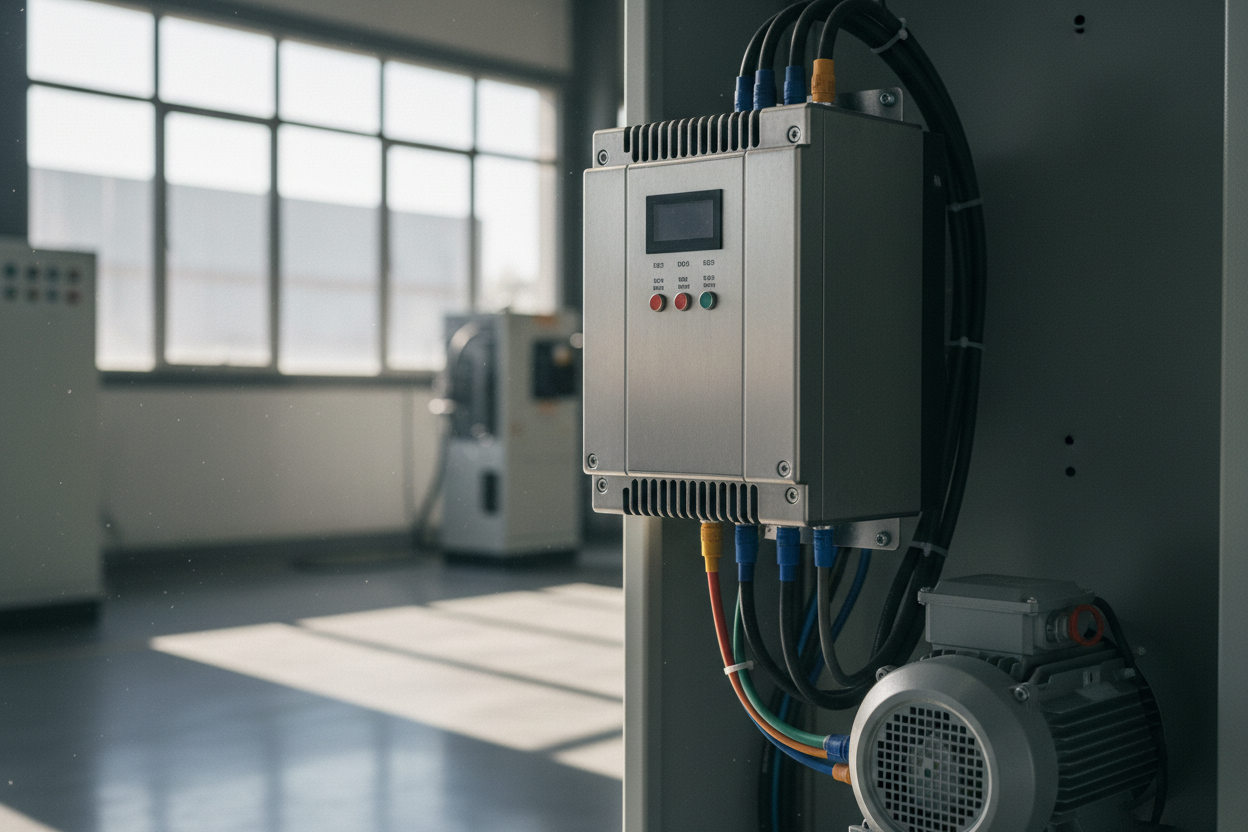
Inside a VFD, a rectifier converts incoming AC to DC, while capacitors smooth the DC bus. An inverter stage, typically using fast-switching power semiconductors, reconstructs AC at a commanded frequency and voltage. The output uses pulse-width modulation (PWM), where high-frequency switching produces a waveform whose average value approximates a sine. Adjusting the duty cycle shapes the effective voltage and frequency, letting the drive deliver the torque the system demands. To maintain motor magnetizing flux, many drives follow volts-per-hertz (V/f) profiles, increasing voltage proportionally with frequency. At low speeds, boost functions enhance starting torque. Controlled acceleration reduces mechanical stress and electrical peaks compared to across-the-line starts. While PWM introduces switching-related harmonics, proper cable practices, line reactors, and optional filters can mitigate effects on both the power system and the motor. Modern drives also allow selection of carrier frequency to balance acoustic noise, motor heating, and electromagnetic considerations, aligning performance with the needs of the application.
Control Strategies for Speed and Torque
VFDs offer a spectrum of control methods to match complexity and performance goals. Basic open-loop V/f control is robust and simple, suitable for many pumps, fans, and conveyors. For tighter regulation and dynamic response, vector control and field-oriented control (FOC) mathematically decouple torque and flux, allowing rapid, precise adjustments. With encoder feedback, closed-loop operation delivers excellent low-speed torque and positioning capabilities, while slip compensation keeps speed steady under changing loads. Built-in PID control can regulate process variables like pressure or temperature directly from sensor inputs, reducing the need for external controllers. Configurable acceleration and deceleration ramps, including S-curve profiles, manage shock and resonance. When fast deceleration is needed, dynamic braking with a resistor dissipates energy; for energy recovery, regenerative front ends can return power to the grid or common bus. Multi-motor coordination, master-follower modes, and application macros streamline commissioning, ensuring the drive's control strategy matches the mechanical system.
Motor Behavior and System Integration
Different motor types respond uniquely to VFD control. Induction motors are common and cost-effective, relying on slip between the rotating field and rotor to develop torque. Permanent magnet and synchronous reluctance designs offer higher efficiency and excellent low-speed performance, often benefiting from vector or FOC control. VFD outputs have high dv/dt, which can stress insulation, especially with long cables; using shielded cable, proper grounding, and optional dv/dt or sine filters mitigates heating and common-mode currents. Bearings can experience electrical discharge; shaft grounding and insulated bearings help protect them. At low speeds, reduced self-cooling may necessitate an external fan or derating. Torque-speed curves, load inertia, and mechanical resonance inform ramp times and maximum speed limits. Consider the environment, cabinet ventilation, and cable routing for EMC. Line-side reactors or passive filters can reduce harmonic distortion. Integrating the drive with sensors, I/O, and a controller ensures the full system—from power input to process output—works together reliably.
Installation, Tuning, and Safety Practices
Proper sizing and setup are crucial for reliable VFD performance. Select a drive for the motor's voltage, current, and overload requirements, considering duty cycle and ambient temperature. Commissioning begins with verifying wiring, grounding, and protective devices, then entering motor nameplate data and running an autotune to identify electrical parameters. Configure current limits, torque limits, and protection for overvoltage, undervoltage, overcurrent, and thermal overload (I²t). Set ramp times and braking methods to avoid trips and mechanical stress. Safety features like Safe Torque Off (STO) support functional safety strategies; coordinate with e-stop circuits and lockout procedures. Keep enclosures ventilated and clean to avoid heat buildup, and verify that cable shields are grounded at both ends for EMC performance. Consider bypass arrangements or contactors only when necessary and in ways that do not compromise protection. Routine maintenance—checking fans, capacitors, connections, and event logs—helps catch issues early, maintaining uptime and consistent motor performance.
Applications and Benefits Across Industries
VFDs deliver compelling advantages in many motors applications. In pumps and fans, affinity laws show that small speed reductions can yield large energy savings, while soft starts reduce water hammer and duct stress. Conveyors benefit from smooth acceleration, speed matching, and gentle stopping that protect products and gearboxes. In mixers, compressors, and machine tools, precise torque and speed control stabilize quality and throughput. Built-in logic, I/O, and communications integrate drives with automation systems, enabling coordinated control, recipe management, and remote diagnostics. Advanced features like multi-pump sequencing, sleep modes, and anti-cavitation control improve efficiency and reliability. Beyond savings, VFDs reduce mechanical wear, lower noise, and enable right-sized processes that respond to demand. When constant speed truly suffices, across-the-line starters remain viable; however, whenever variable flow, better process control, or reduced stress is valuable, VFDs provide a flexible, scalable path to performance, efficiency, and measurable operational improvement.