Brushless vs Brushed Motors: What's the Difference?
Brushless and brushed motors differ in design, efficiency, control, lifespan, cost, and maintenance. Learn which type fits your project and budget.
Fundamentals of Brushed and Brushless Designs
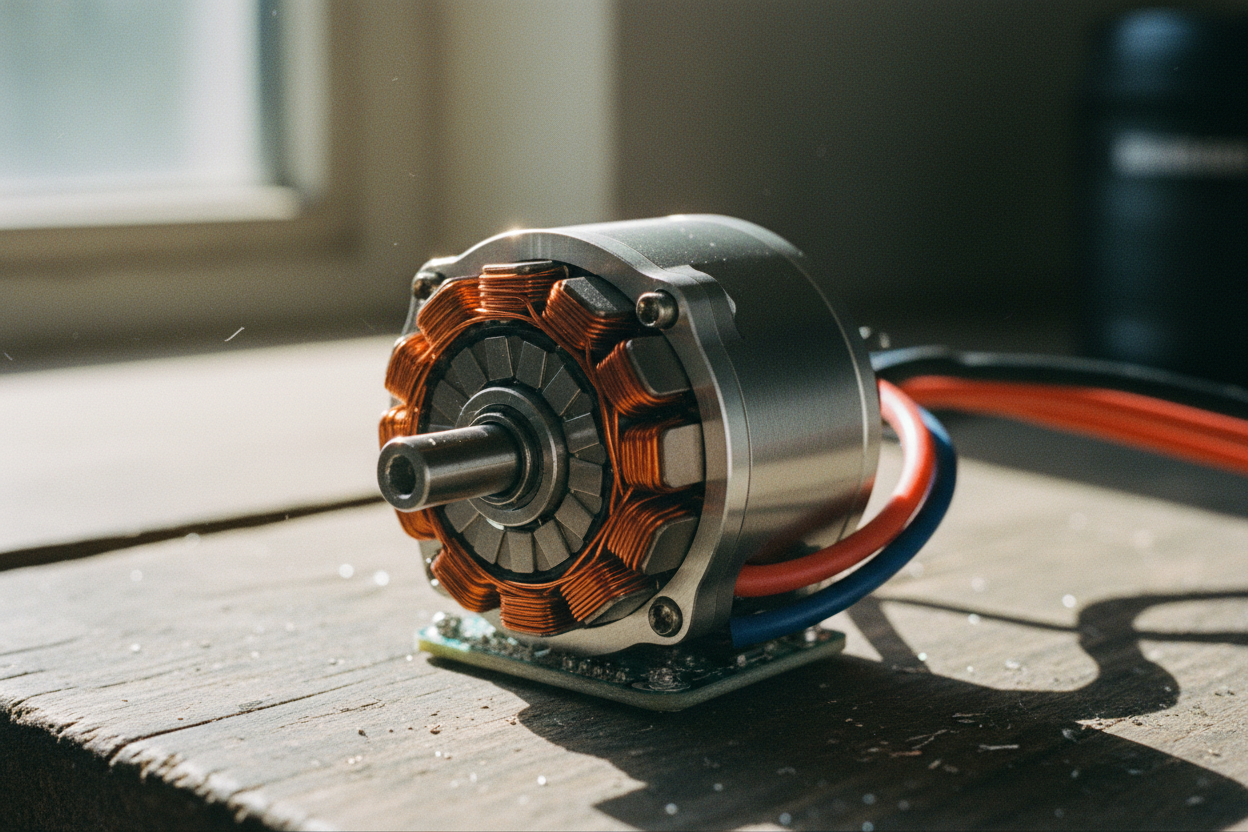
A brushed motor uses carbon brushes that press against a segmented commutator to mechanically switch current through the rotating armature. This direct, physical commutation makes control simple but introduces friction, electrical arcing, and heat at the contact points. A brushless motor inverts the arrangement: the rotor carries permanent magnets, the stator holds the windings, and an electronic controller handles commutation. By energizing the stator phases in sequence, the controller creates a rotating magnetic field that pulls the rotor along. This architecture eliminates brush wear, reduces resistive and contact losses, and allows more precise timing tied to back-EMF or Hall sensors. Because there is no sliding electrical contact, brushless designs often run cooler and endure harsher duty cycles with less maintenance. Meanwhile, brushed motors remain attractive for their straightforward wiring, instant compatibility with basic DC supplies, and predictable behavior, making them common in entry-level devices, simple actuators, and applications where cost and simplicity outweigh peak efficiency.
Efficiency, Power Density, and Performance
When comparing efficiency, brushless motors typically convert more electrical energy into mechanical work due to the absence of brush friction and optimized electronic commutation. Their higher power density enables compact packages that deliver strong torque and rapid acceleration, especially at higher speeds where mechanical commutators can become limiting. Precise control of phase timing, duty cycle, and current also improves partial-load performance, which matters in battery-powered systems seeking longer runtime. Brushed motors, by contrast, are often favored for dependable startup torque, smooth low-speed response with simple PWM control, and tolerant behavior under varying loads. However, brush contact losses, arcing, and heat buildup typically reduce sustained efficiency and may cap continuous output. Brushless architectures further benefit from intelligent strategies like field-oriented control or adaptive timing to mitigate cogging torque and enhance smoothness. For many users, the practical takeaway is that brushless motors deliver a superior balance of continuous efficiency, thermal stability, and power-to-weight, while brushed motors offer functional performance with minimal electronics.
Durability, Maintenance, and Reliability
A primary advantage of brushless motors is reduced maintenance. Without brushes, there is no consumable component producing dust or requiring periodic replacement, and electrical contact surfaces do not degrade over time. The main wear items become bearings, which are easier to service or replace and are not unique to any one topology. This translates to consistent performance across long duty cycles and better reliability in environments where debris, vibration, or frequent start-stop operation is expected. Brushed motors inherently experience brush and commutator wear. Brush material, spring tension, and operating current influence lifespan, and heavy loads can increase arcing and pitting on the commutator. While many brushed designs are robust and field-proven, they benefit from routine inspection to manage heat, brush residue, and surface condition. For both types, proper thermal management, correct voltage and current sizing, and protection against overload or stall conditions are crucial. With sensible derating and cooling, either motor can be reliable, but brushless systems usually demand less ongoing attention.
Control, Noise, and User Experience
Control electronics shape the day-to-day experience. A brushed motor can be driven directly from a DC source, with polarity reversal for direction and simple PWM from an H-bridge to modulate speed and torque. This simplicity reduces cost and integration complexity, making quick prototypes and straightforward systems easy to build. A brushless motor requires an ESC that sequences phases and monitors rotor position via back-EMF or sensors. The payoff is exceptional speed regulation, programmable torque limits, smooth ramp profiles, and features like regenerative braking. In terms of acoustics, brushed motors may generate mechanical noise from brushes and the commutator, while brushless motors can produce a tonal switching sound tied to control strategy and PWM frequency. With advanced algorithms such as field-oriented control, brushless systems achieve remarkably quiet and precise motion, especially at low speed. For applications demanding gentle starts, tight speed hold, and minimal EMI, the refinement of brushless control can significantly elevate the user experience.
Cost, Applications, and How to Choose
Cost often frames the decision. Brushed motors typically carry a lower initial price and pair with inexpensive drivers, which is attractive for high-volume devices or short duty cycles. However, consumable brushes, periodic service, and lower efficiency can raise lifetime costs, particularly where energy use or downtime matters. Brushless motors usually cost more upfront due to the ESC and magnets, yet they pay back through energy savings, longer service intervals, and superior performance in continuous or demanding roles. In practice, brushed solutions fit simple conveyors, basic actuators, compact fans, or budget tools where plug-and-play operation is key. Brushless solutions excel in drones, e-bikes, premium power tools, robotics, and HVAC systems where torque control, efficiency, and longevity drive value. To choose wisely, map your torque-speed profile, runtime, environment, and maintenance capabilities. If you prioritize precision, quiet operation, and durability, go brushless. If rapid deployment and minimal electronics dominate, a brushed motor can be the pragmatic pick.